Author Guidelines
The rules for submission of article are as follows:
1.Acceptable text formats: MS Word (.doc,.docx).
2. Acceptable graphic formats for figures: TIFF, GIF, JEPG.
Maximal term of rewiewing is 20 days.
The term between publication and submission of article is 3-4 month.
The Journal does not charge authors any fee for submitting and publishing their manuscripts
Article structure
The article must be designed according to the Decision of HAC №7-05/1 of 15 January 2003 "On increasing requirements for professional publications, listed by HAC of Ukraine". The article is to contain logically interrelated sections. All sections must start with heading in bold.
Introduction (statement of the problem in general form and its connection to important scientific and practical tasks; analysis of recent research and publications where beginning of solution of existing problems is and on which the author refers to; unsolved aspects of the problem, separation of unsolved earlier parts of general problem to which article is dedicated).
Task statement (research objective, methodology and data).
Results (main research material with justification of derived scientific results).
Conclusions (conclusions of research, recommendations for further research in this area).
Bibliographic list (at least 8 sources). Each position in the bibliographic list should have a reference in the text. For a bibliographic list in the original language, Ukrainian State Standard (ДСТУ) 8302:2015 should be used (Read more...)
For a bibliographic list (References) in English, style MLA should be used (Read more...)
Abstract must be identical in content in Ukrainian, Polish (only for articles written in Polish) and English. Abstract should be no less than 1800 characters and cover the following structural issues: theme of the article, purpose, methods of research, results, scientific novelty, theoretical and practical significance. Before the annotation in the appropriate language the names and initials of all authors, title, and address of the organization (for each author) should be indicated.
Key words must be written in in Ukrainian, Polish (only for articles written in Polish) and English. Their number should not exceed ten units.
Technical requirements
The article should be made in text editor Microsoft Word (file must have the extension *.doc * .docx or *.rtf). The file name in Latin letters should match the last name of the first author (example: Petrenko.doc, Petrenko.rtf). Margins on all sides - 25 mm. Type - Times New Roman Cyr, Size - 12. Interval -1.
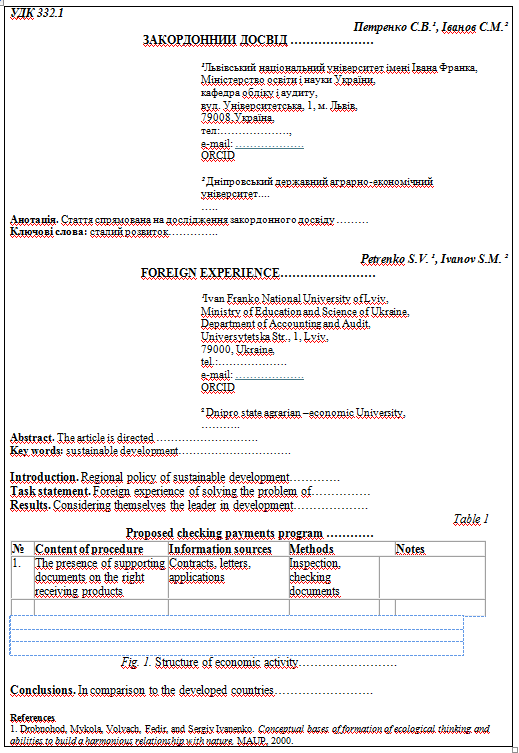
Articles should be formatted in the following order:
- Section
- UDC in the upper left corner of the page, in bold italics, font size 12;
- Last name and first name of authors in Ukrainian, aligned to the right margin, typed in bold italics, font size 12;
- TITLE OF THE ARTICLE in Ukrainian, centered, in capital letters, bold, font size 12;
- Institution where the work was carried out in Ukrainian (name of the institution, departmental affiliation, postal address, postal code, telephone number), e-mail and ORCID of the authors. If the group of authors includes representatives from different institutions, the affiliation of each author should be indicated - font size 11, regular;
- Last name and first name of authors in English, aligned to the right margin, typed in bold italics, font size 12;
- TITLE OF THE ARTICLE in English, centered, in capital letters, bold, font size 12;
- Institution where the work was carried out in English (name of the institution, departmental affiliation, postal address, postal code, telephone number), e-mail and ORCID of the authors. If the group of authors includes representatives from different institutions, the affiliation of each author should be indicated - font size 11, regular;
- For articles written in Polish, additional information about the authors, the title of the article, and the affiliation (place of work) must also be provided in Polish.
- Article text (according to the above-mentioned structure) – font size 12, regular;
- Bibliographic list and References (list of sources) – font size 10, regular;
- Information about the author(s): Last name and first name, scientific degree, academic title, position, institution, postal address for correspondence, work / mobile phone numbers with area code, e-mail.
Illustrations (schemes, graphs, diagrams) should be submitted additionally in file format * .tiff. Digital material must be given in the table that has a serial number, right-aligned (eg. Table 1) and name (printed below the table in the middle with bold letters, for example, Features of policy of sustainable development in foreign countries). The titles of figures and tables should be provided in the original language and in English. After the tables and figures the source ([ ], the author`s ellaboration;, compiled by the author based on [], etc.) must be indicated. Illustrations should also be numbered and they should have names that appear outside the graphic object (eg, Fig. 1. Classification of priorities for innovation activity of small business and sources of its funding). Illustrative material must be contrasting black and white. Formula (with standard numbering) must be performed in the editor Microsoft Equation. Captions of figures and formulas should be available for editing. All graphics should not be scanned.
References in the text should be given in square brackets, eg, [4, p. 31; 2, p. 21-39], in which the first digit indicates the serial number of the source in the bibliography, and the second - the appropriate page in the source. One source is separated from the rest by a semicolon [1; 2; 5; 8; 11; 19].
Editorial board is not responsible for the information included in the article.
The author is responsible for the originality of the text of the article (author is responsible for plagiarism), accuracy of facts, quotations, statistics, proper names, place names and other information, as well as the fact that the materials do not contain information that must not be open publishing.